
We are back to traveling through Ruthmere’s Steinway piano and exploring different parts of the world through Rubinstein. If you are an art lover or adore movie stars from old Hollywood, you want to keep reading. We will start in Spain.
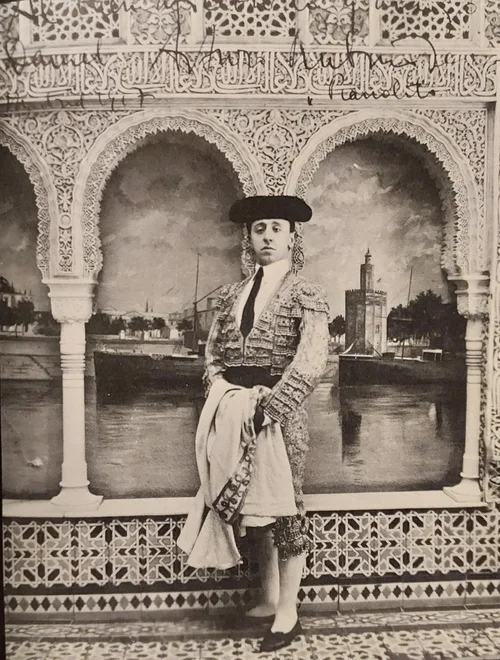
Arthur Rubinstein in Madrid, ca. 1917
Rubinstein had an intrinsic love for Spain and this is where his career started to become significantly successful. The Spanish public adored him and considered him a true Spaniard because of how well he could play their music in the authentic Spanish idiom. Spain is also where Rubinstein met Picasso. They met at an intermission of a concert in Madrid, talked for hours and became lifelong friends before they both became famous. Rubinstein describes visiting Picasso’s atelier in his French apartment where he painted. Dozens of canvases were stacked facing the wall and there was a little table with paint all over it and brushes in earthenware. According to Rubinstein, the only beautiful thing in the room was a painting of a guitar on a chair with a wine bottle on a table, a newspaper and glasses and Picasso’s balcony in the background. Rubinstein was astonished how Picasso could give such commonplace items a life and color. Picasso hated empty words and believed that there are no words to describe his paintings. You simply love or hate them. One time, Rubinstein said he could not resist asking Picasso why he painted the same scene over and over. Picasso explained that each day is different therefore lighting is different and that creates a new picture every day. This was a great musical lesson for Rubinstein. He realized that when he plays repeated music at his concerts, he always feels like he is playing the piece for the first time.
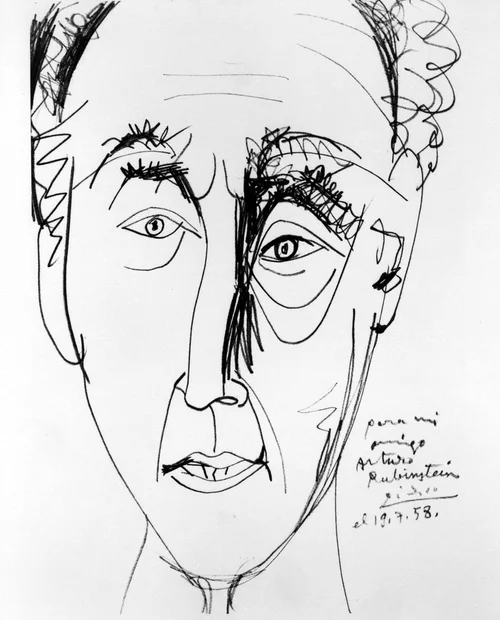
A sketch of Arthur Rubinstein by Picasso, circa 1958
Later in life, Picasso and Rubinstein met again at the Cannes Film Festival in the mid-1950s. Picasso invited Rubinstein to his apartment to show him some of his new paintings as well as his sculptures. Rubinstein called himself a passionate lover of art and was more awestruck by his sculptures than his paintings. Decades earlier, Picasso had given Rubinstein a painting they called “blue” and a drawing of Rubinstein but unfortunately they were lost in WWII, so Picasso offered to do more sketches of Rubinstein. Picasso asked if Rubinstein wanted full resemblance of himself and he replied not at all, but to sketch only what Picasso could see in him. He began sketching page after page until 3 hours had passed and he filled a 24 page sketch book. Each picture, according to Rubinstein, looked different and had a different character. He generously let Rubinstein have 4 of the pictures and signed and dated them. Another time, Picasso took Rubinstein to Vallauris to show his ceramic exhibit. Rubinstein fell in love with a vase of his and offered to buy it but was told that all the copies were already sold. Seeing Rubinstein’s sad expression, Picasso decided to make 1 more copy, sign it and send it to his house in Paris.
After Spain, Rubinstein’s concert career led him to South America. Now we travel to Brazil where Rubinstein met a French composer named Darius Milhaud and a Brazilian composer Heitor Villa-Lobos, whom Rubinstein said were the most prolific composers of his time. Villa-Lobos is one of the most well-known composers of the 20th century in South America who studied indigenous Brazil to create his own music that combined western music with indigenous rhythmical and melodic elements. Rubinstein, while in Brazil, heard from people that Villa-Lobos relied entirely on his own musical genius and was expelled twice from his music conservatory for rejecting criticism from teachers. Upon hearing this, Rubinstein wanted to meet him. Rubinstein heard lots of negative things about the composer and experienced some of his own disagreements with him but was very impressed with his music and how he used Brazilian rhythms in a completely original way. He was convinced that Villa-Lobos was a great composer with something important to say. Rubinstein helped promote Villa-Lobos’s music by helping him break into the music scene in Paris, where his music was actually appreciated and loved. Villa-Lobos gained notoriety in Paris and Rubinstein added Brazilian music to his own repertoire for concerts.
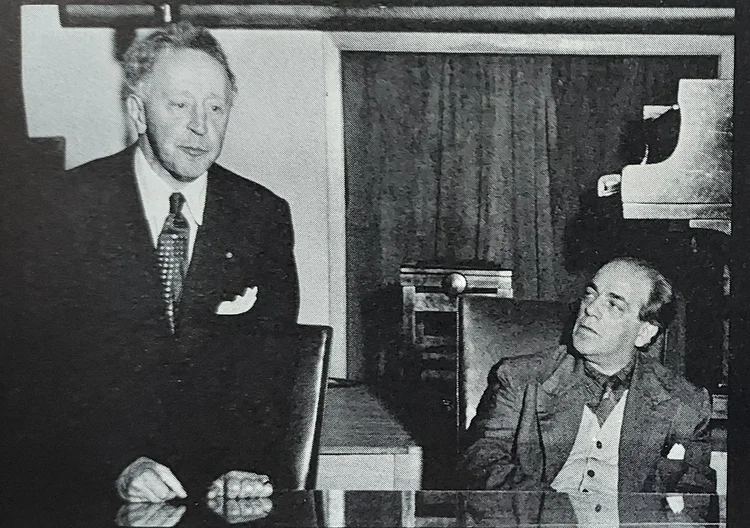
Arthur Rubinstein with Heitor Villa-Lobos, date unknown
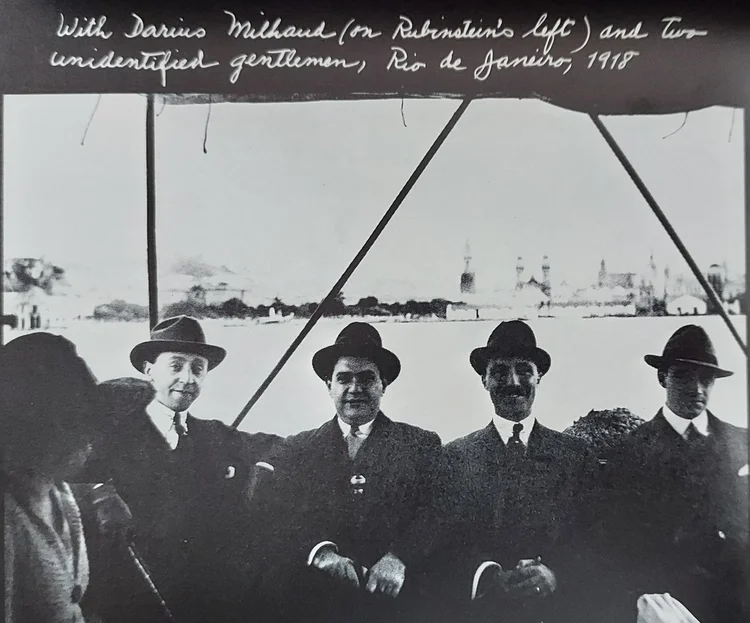
Arthur Rubinstein with Darius Milhaud (on his left) and two unidentified gentlemen, Rio de Janeiro, 1918
Arthur Rubinstein in Madrid, ca. 1917
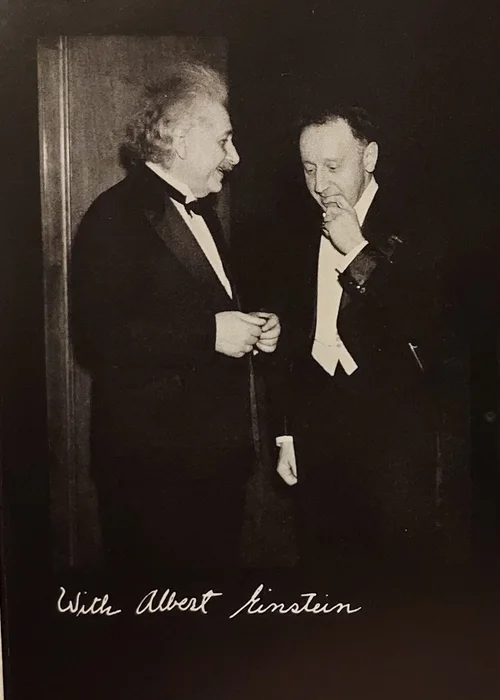
Now we go to North America, where Rubinstein and his family took refuge from the Nazis during WWII and became naturalized citizens. Soon after Rubinstein and his family arrived in America to seek refuge from Hitler, he had a call from a man in Philadelphia named Fred Mann. He was calling to invite Rubinstein to a dinner that Mann was giving for the benefit of the newborn Israeli Orchestra. Albert Einstein would also be at the dinner and was seated at Arthur Rubinstein’s table of honor. Rubinstein treasured the photo of the two of them and jokingly describes himself as having a “serious deferential face that has the air of a deep-thinking philosopher while Einstein’s long hair and broad smile make him resemble a German café fiddler.” Einstein, commonly known as an amateur violinist, was very interested in hearing Rubinstein play at this dinner and was very pleased with him playing a Chaconne of Bach arranged by Busoni.
Rubinstein spent 13 years living in California, first in the Brentwood neighborhood of LA and later in Beverly Hills. Some friends gave Rubinstein and his family a welcome party when they first arrived. This is where they first met movie stars such as Charlie Chaplin, Bette Davis, Hitchcock, Rex Harrison, and Errol Flynn. Charles Boyer was also there, whom Rubinstein called an old friend from Paris, and Boyer later introduced Rubinstein to his French Hollywood friends. Rubinstein first rented in Brentwood, but then later bought a house from Pat O’Brien who was the most famous Hollywood actor in the 30s and 40s. Pat O’Brien gave Rubinstein a great discount on the house, but said he would have given it to him if he would have only given piano lessons to O’Brien’s daughter. Rubinstein’s younger children would also have parties with children of local celebrities and among them were Liza Minelli and Candace Bergen. Rubinstein’s son Johnny formed quite the attachment to Candy Bergen. Other friends mentioned to attend Rubinstein’s parties were David Selznicks and Cary Grant.
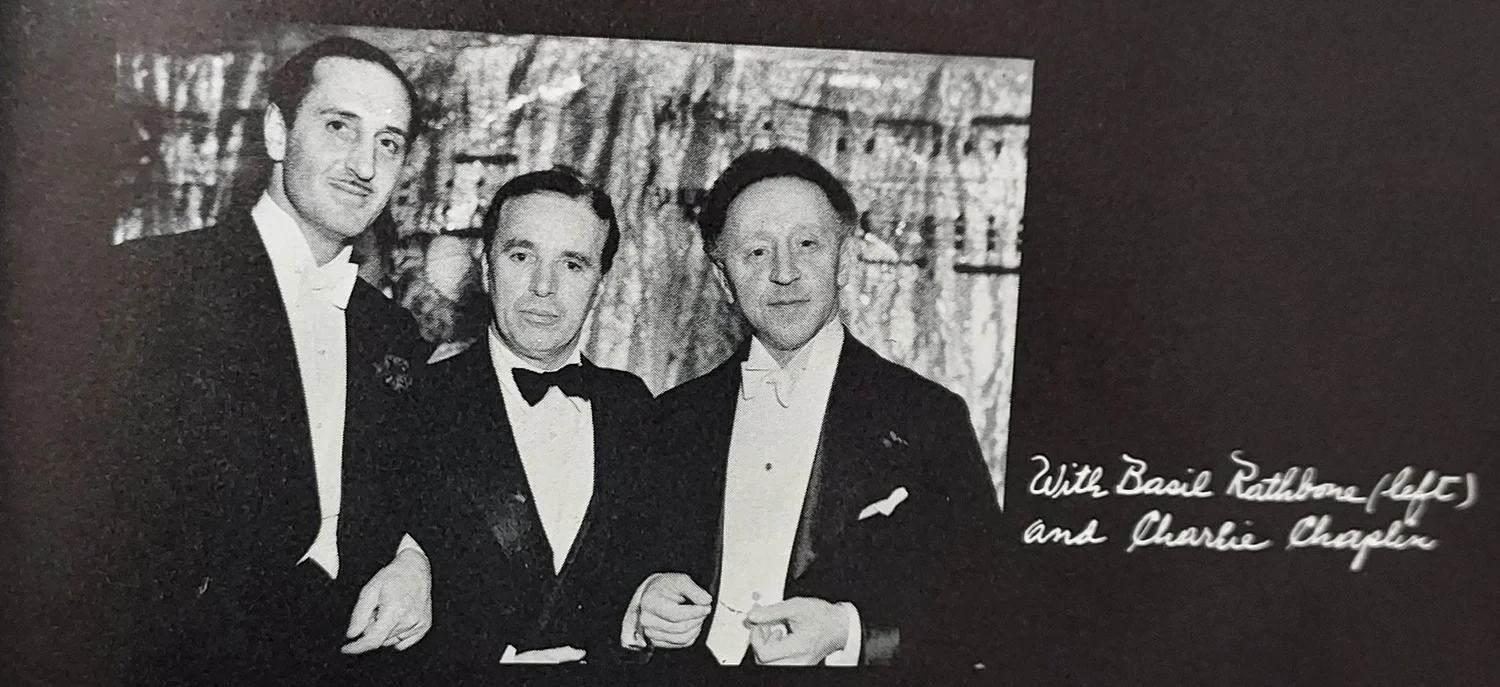
Basil Rathbone, Charlie Chaplin, and Rubinstein, date unknown
Rubinstein also played piano for several Hollywood movies. The first movie, I’ve Always Loved You, was about a young pianist and conductor but Rubinstein was not interested in how they portrayed the pianist’s life and refused to participate. The film director enticed Rubinstein to play with giving him a large say in details of the movie. Jack Warner from Warner Brothers also approached Rubinstein to play in another movie, but he didn’t see any artistic merit in the story. Jack Warner accused musicians of not having a sense of humor and Rubinstein clapped back with “we don’t do it for the money.” Rubinstein said he “fell into the trap” of another movie by accepting a role in a Columbia Pictures’ movie Carnegie Hall. Rubinstein also played in an MGM movie, Song of Love, about the famous composer Robert Schumann, which was a very moving project for him. He said that Katharine Hepburn played the concertos of Liszt and Schumann as if she were a born pianist while Rubinstein played for the soundtrack. Rubinstein also won an Oscar for a movie made about his life. On the internet, you can watch the video of the award being accepted by his wife because Rubinstein was very shy about recognition, but Gregory Peck personally visited Rubinstein’s house in Paris to give him the award.
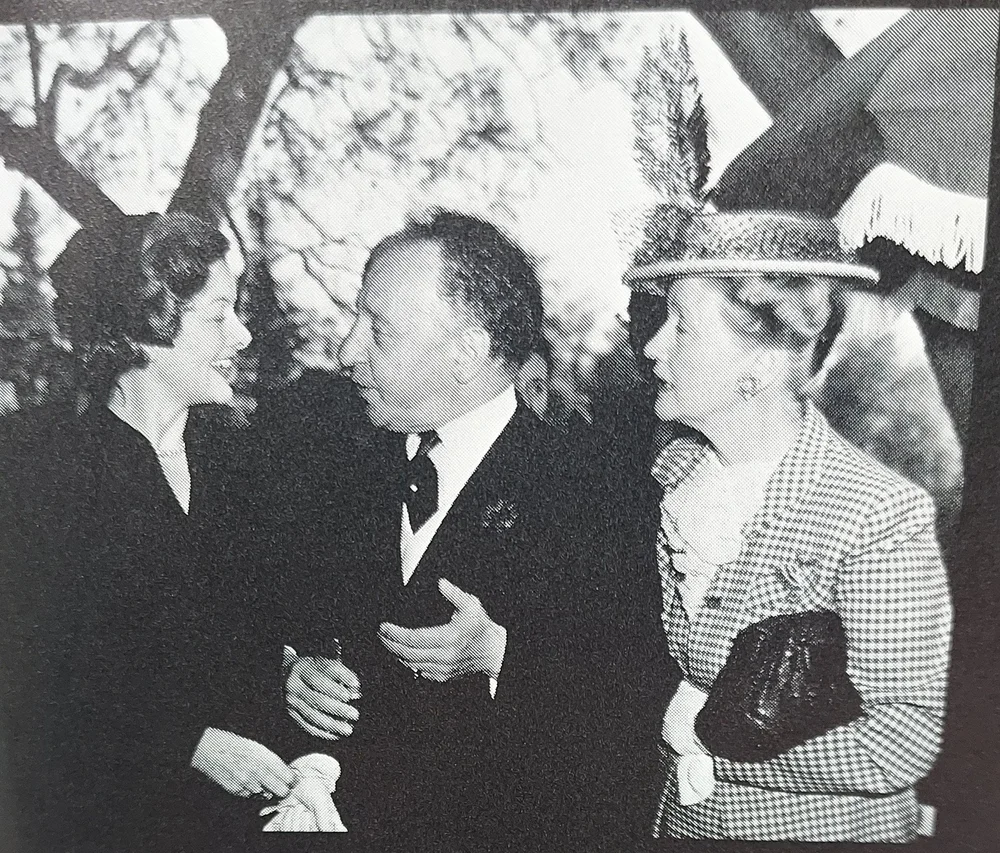
Myrna Loy, Rubinstein, & Hedda Hopper (date unknown)
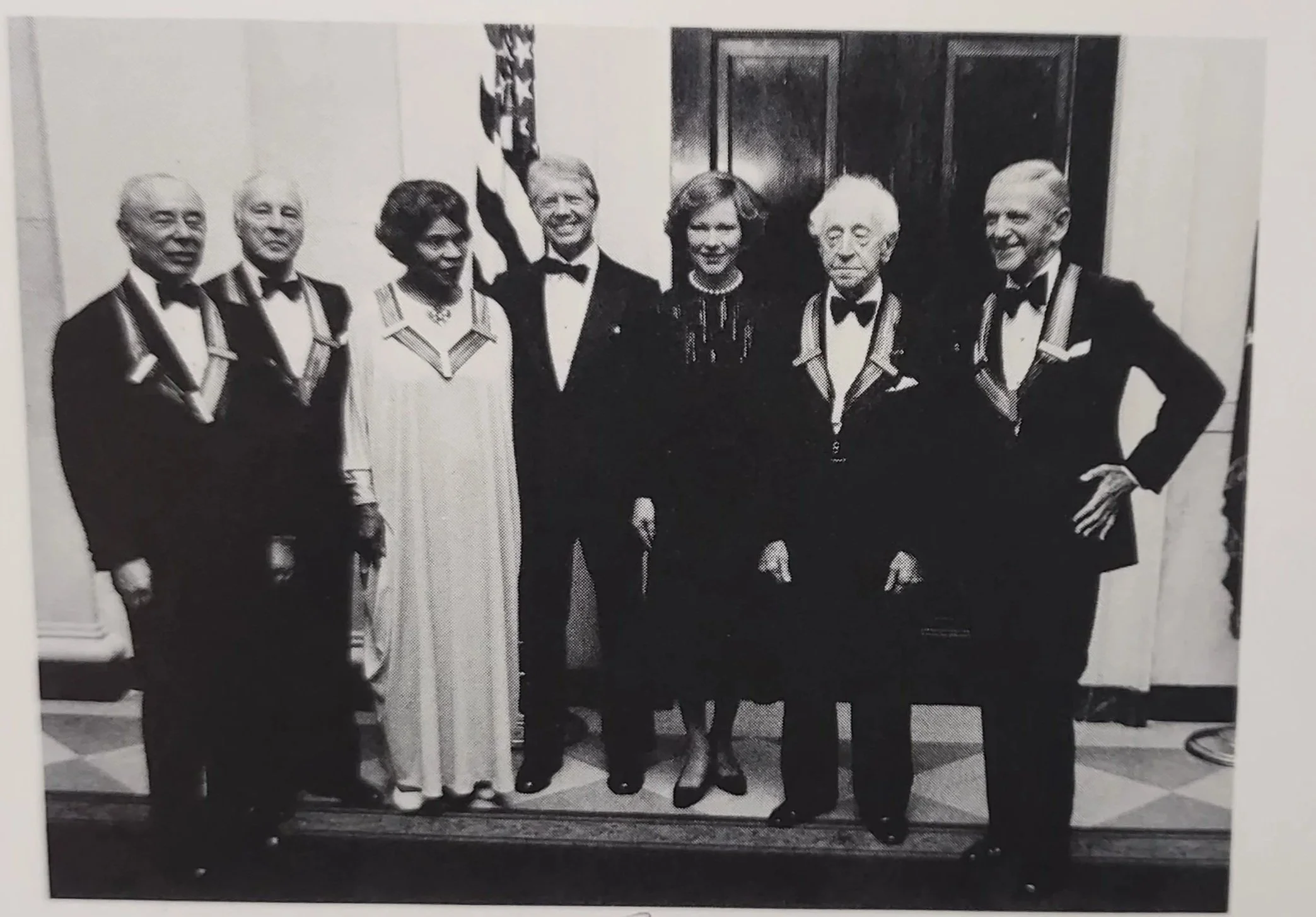
Richard Rodgers, George Balanchine, Marian Anderson, Jimmy Carter, Rosalynn Carter, Arthur Rubinstein & Fred Astaire at the Kennedy Center Honors, ca. 1978
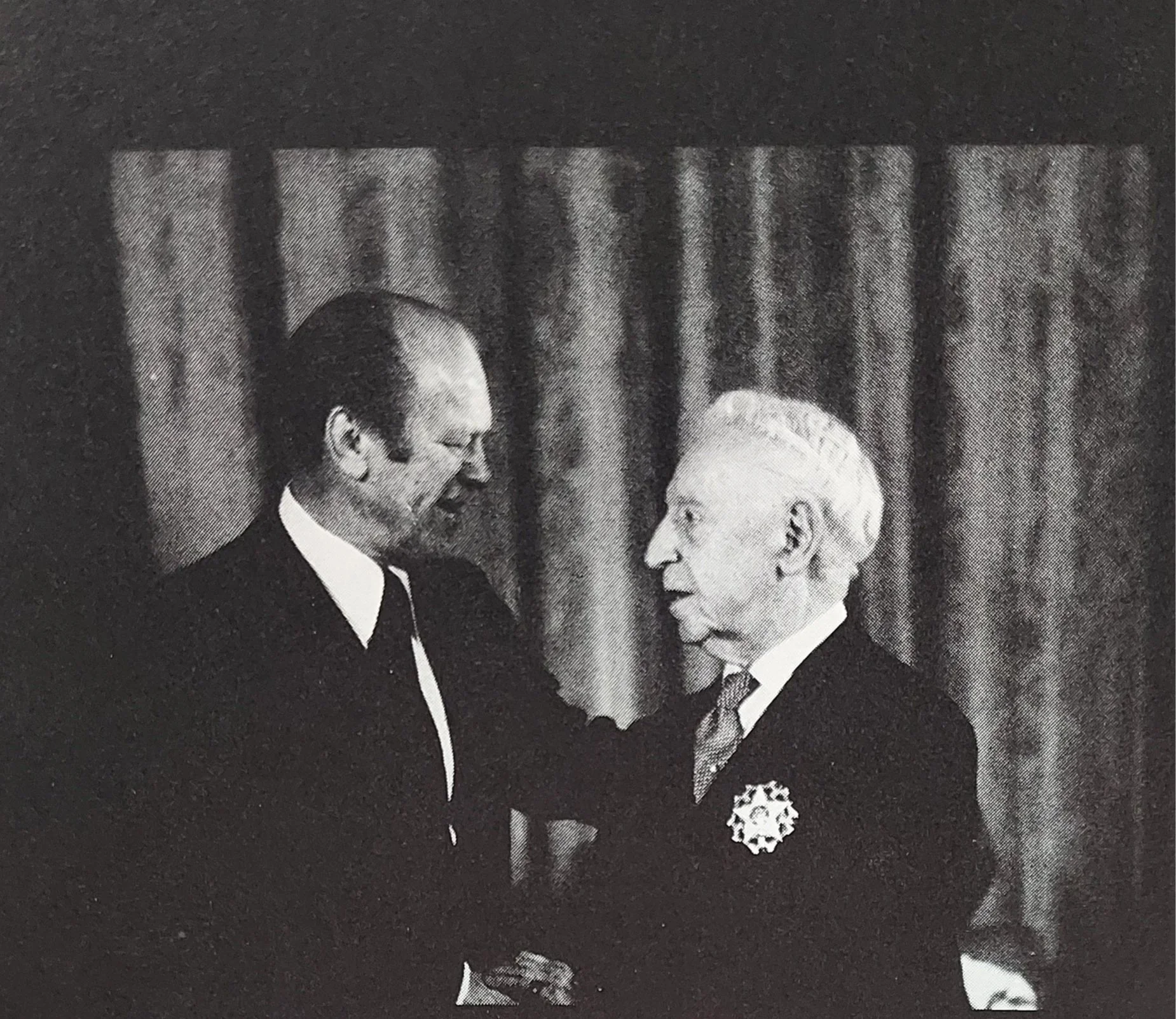
Rubinstein receiving medal of freedom from President Ford, ca. 1976
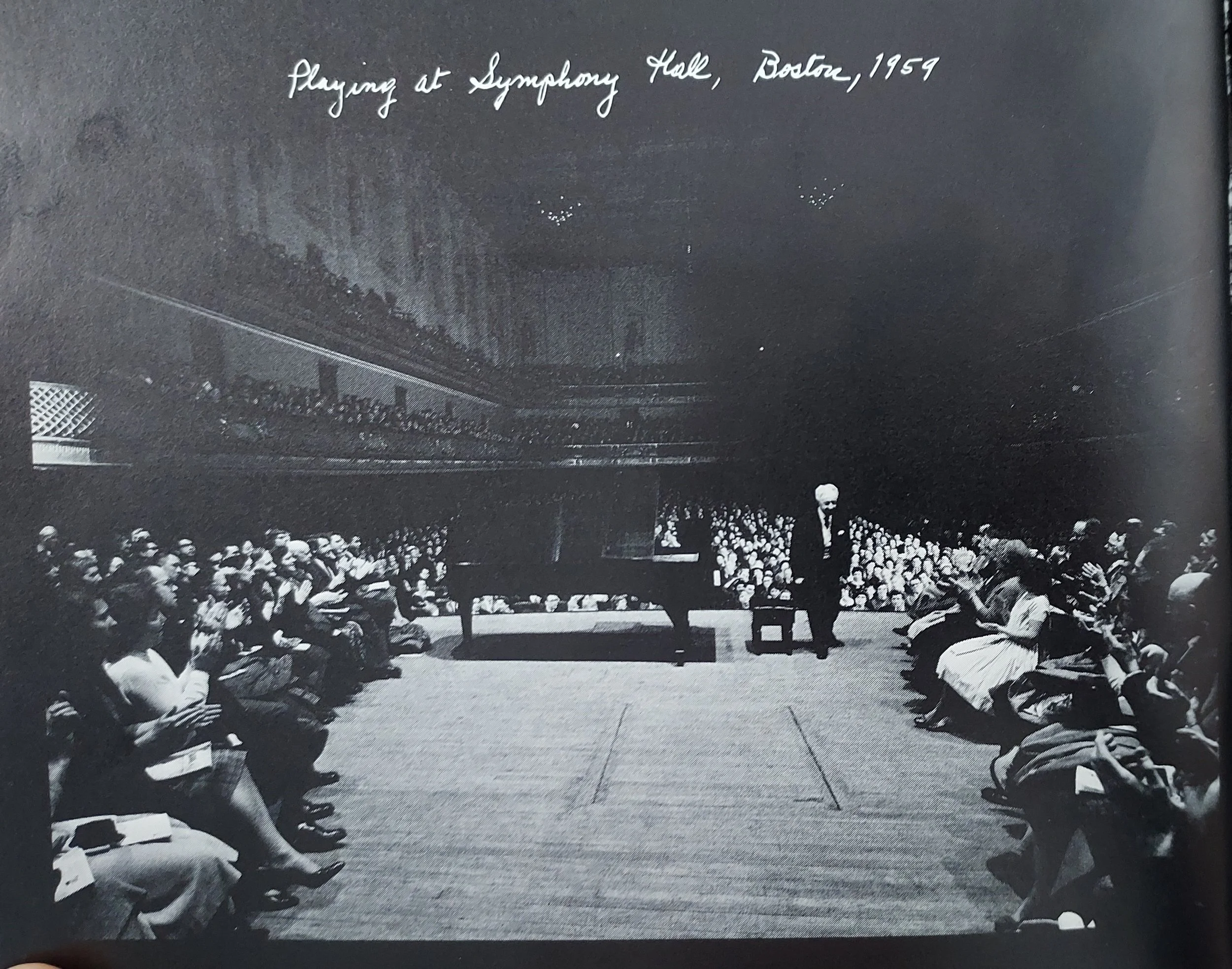
Rubinstein playing at Symphony Hall, Boston, 1959
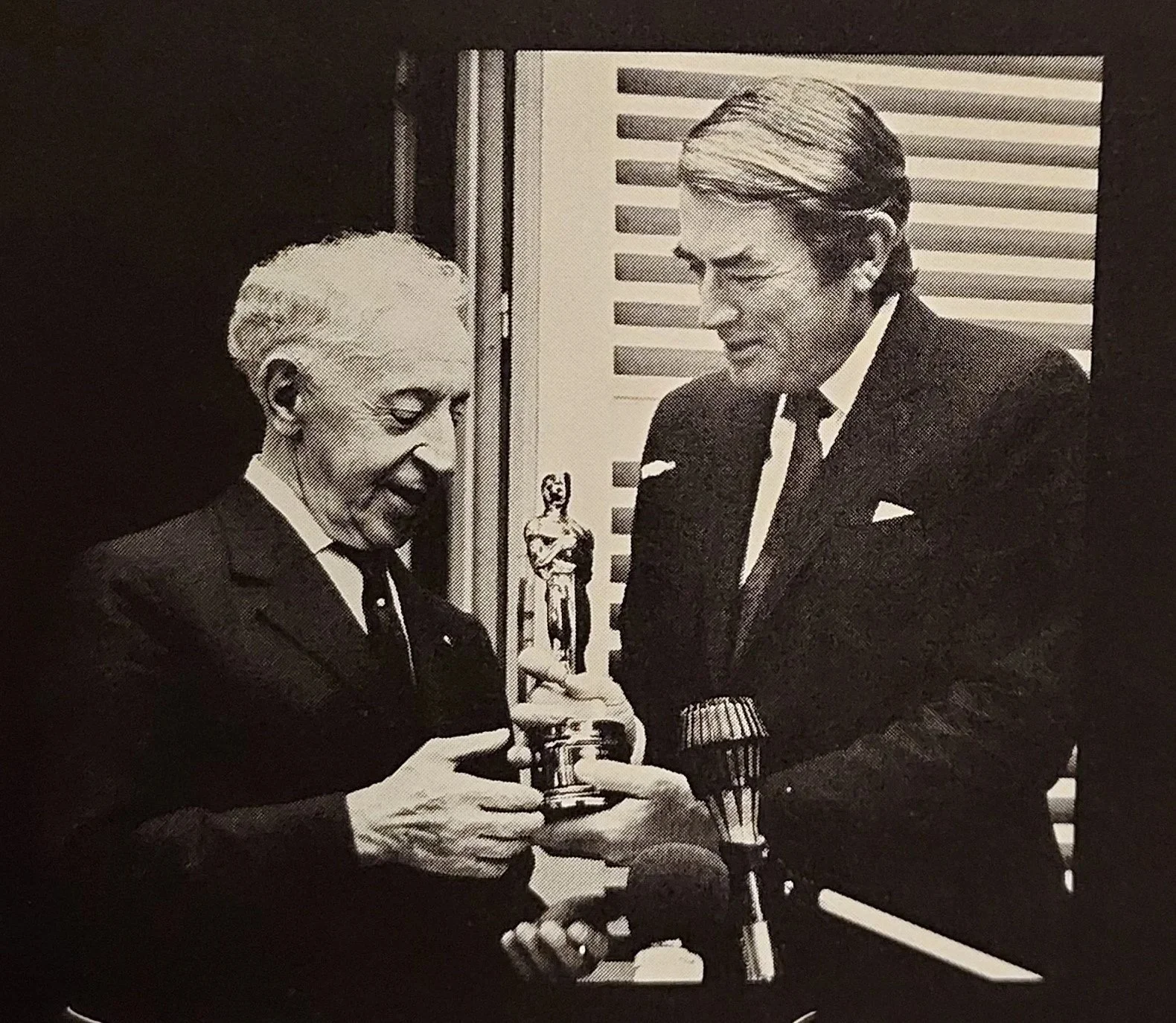
Rubinstein receiving an Oscar from Gregory Peck, 1970
On a concert tour to Australia, Rubinstein had an interesting encounter with Beatlemania. One day, Rubinstein, his wife and two of his children were returning to their hotel while the Beatles were staying in the hotel across the street at the height of their fame. The street was crowded with hippies screaming to their idols. The next morning, Rubinstein had a hard time pushing through the crowd to get to their car to go to the zoo with their children. When they tried to return for lunch, there was a new crowd of people holding up placards that read “We love Arthur,” which meant nothing to Rubinstein because he thought they were shouting for the Beatles. Rubinstein’s son Johnny conveyed to his dad that the crowd was there for him. When the people saw Arthur, they started shouting “long live Arthur” or “we love Arthur” and Rubinstein had to shake hands with a lot of them. According to Rubinstein, when the Beatle fans heard this, they started shouting over the Arthur fans and it seemed that a battle of “Beatleites” and “Arthurites” would ensue, but they somehow made it to the hotel dining room exhausted.
Rubinstein lived an extraordinary life as a pianist, gregarious extrovert and avid learner of art and culture. His stories of his own life and the different people he met are endlessly entertaining and I have only told you a few from his autobiographies My Young Years and My Many Years. I recommend reading them and if you haven’t been to the Ruthmere Museum lately, come take a tour and imagine traveling to different times and places when looking at our wonderful Steinway piano in the Game Room.