
July 4th, 2026 marks 250 years since America declared her independence from Great Britain, turning colonies into states united against tyranny.
This year, the entire country is finding ways to commemorate this monumental milestone. Since most states (including Indiana) did not yet exist even as colonies on that fateful date in 1776, we’re wondering how to include our own stories. That’s not to say there was no one living in these territories. Indigenous groups have been living on this land for thousands of years, and French, English, and Spanish settlers were gradually making their way west, fighting for land in the centuries leading up to the Revolutionary War. In fact, Indiana territory played a vital part in the war; the King of England refused to allow American colonists to migrate west of the Appalachian Mountains, further elevating tensions between the British and the American colonies.
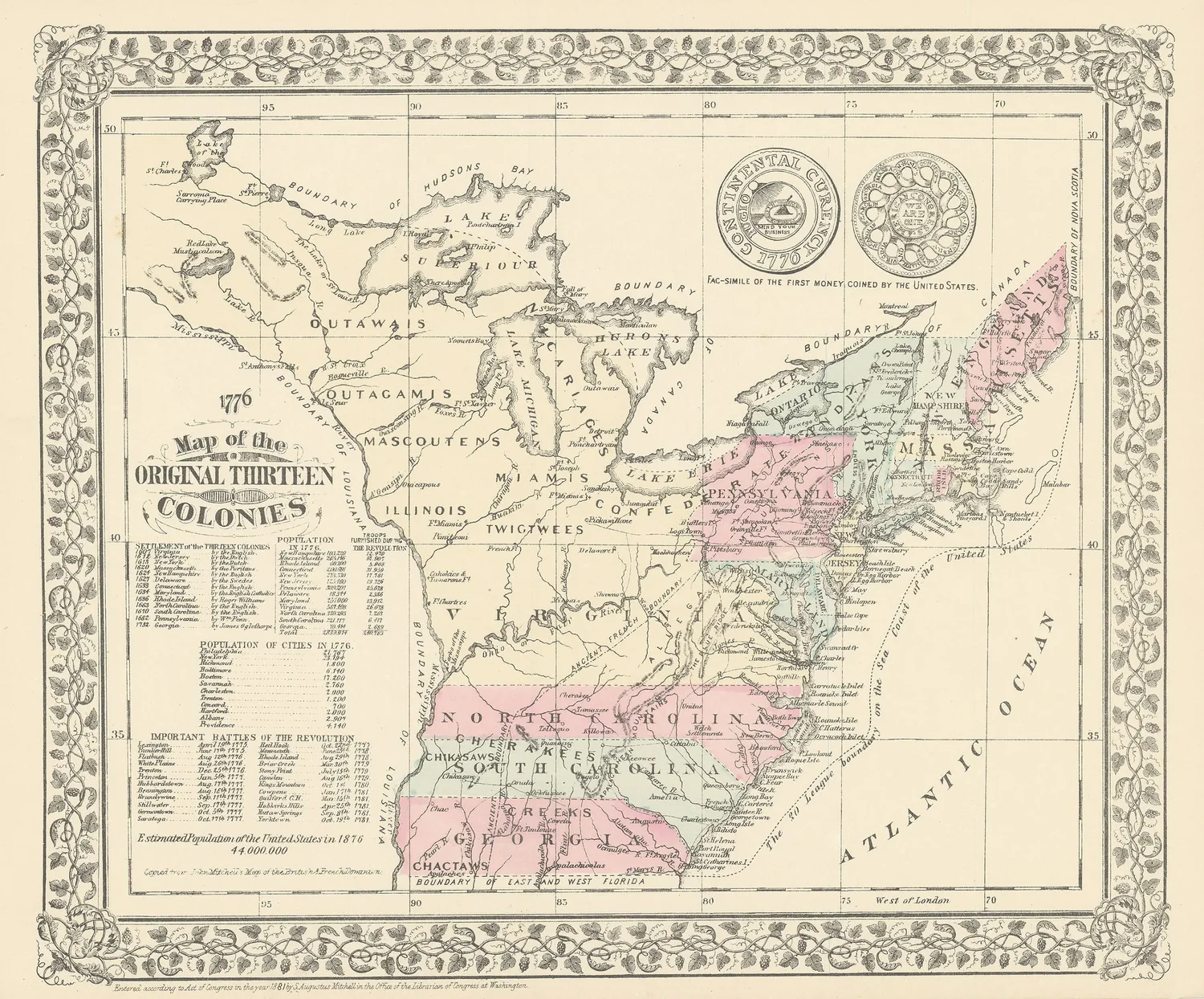
A Map of the Original 13 Colonies. We can see that the proportions were a little inaccurate, but based on the location of the Great Lakes, you can approximate where Indiana would have been. (Right around where it says “Miamis”)
The History Museum of South Bend has a great summary of Indiana history leading up to 1779, which you can read here. It contains an overview of indigenous history, settler expansion, and conflict that explains what Indiana was like during the Revolutionary War.
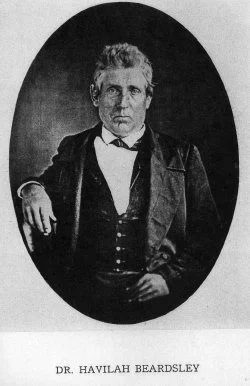
In many cases, the settlers who would lay the literal foundations of the Indiana cities we live in today were not yet in this area 250 years ago. Elkhart’s founding family, the Beardsleys, would not arrive in the land that would become Elkhart until 1829 when Dr. Havilah Beardsley stopped to admire the beauty of the St. Joseph River Valley on his travels.
But how did he get here? Where did he come from? He wasn’t alive yet in 1776 to experience the war, so who was?
The Beardsleys had been in the American colonies since 1635, when Havilah Beardsley’s great-great-great-great grandparents, William and Mary Beardsley, arrived from England aboard a ship called The Planter. They settled in Fairfield County, Connecticut, where they would remain through the next several generations, including the years of the Revolutionary War. In 1776, Havilah’s great-grandfather, Obadiah, his grandparents, Phineas and Ruth, and his parents, Elijah and Sarah Hubbell (not yet married) were all alive to witness the birth of the United States and watch the war unfold. In fact, both Phineas and Elijah joined the Continental Army.
According to Ancestry.com, the family lived in or around the towns of Stratford, New Fairfield, or the historic village of Stratfield (located in modern-day Bridgeport, so-named because it was between Stratford and Fairfield) throughout much of the 18th Century. It appears, based on the locations of the births of Phineas and Ruth’s children, that they relocated from Stratfield (which was a coastal town on the Long Island Sound) to New Fairfield (located further northwest inland) around 1749. New Fairlfield was recently incorporated in 1740.
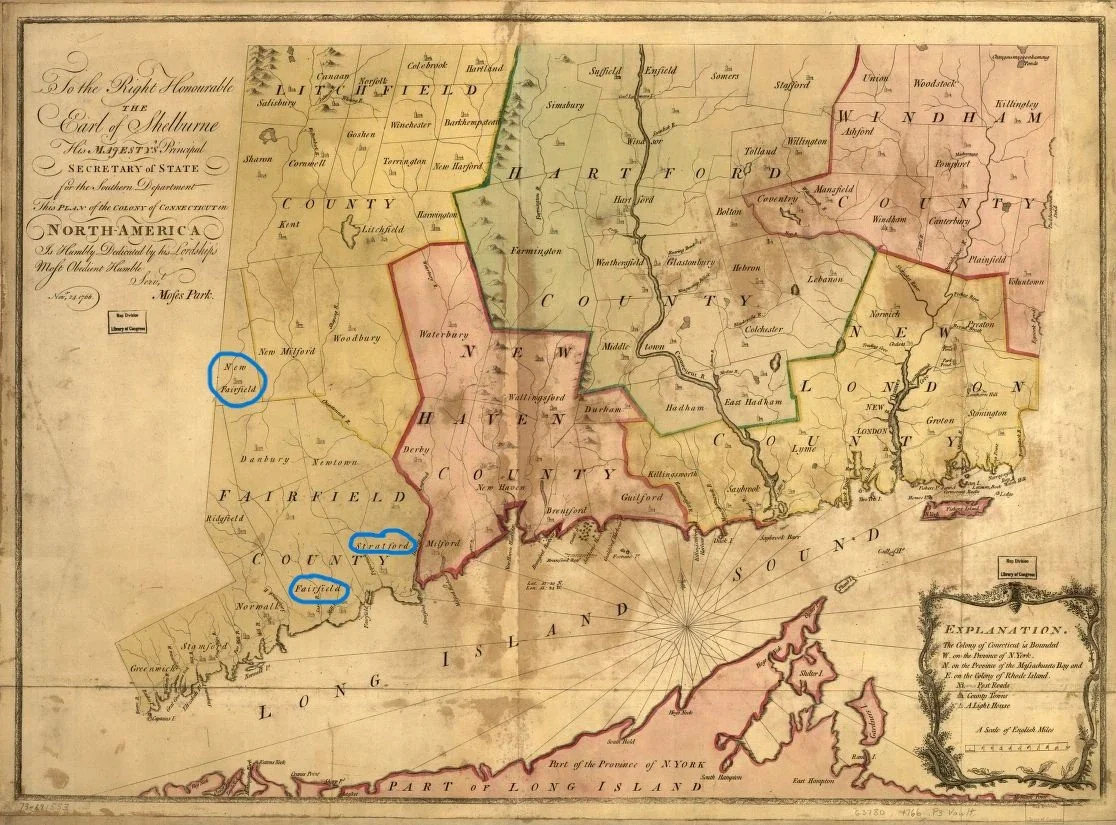
Map of Connecticut ca. 1760s. New Fairfield, Fairfield, and Stratford are all circled on the map.
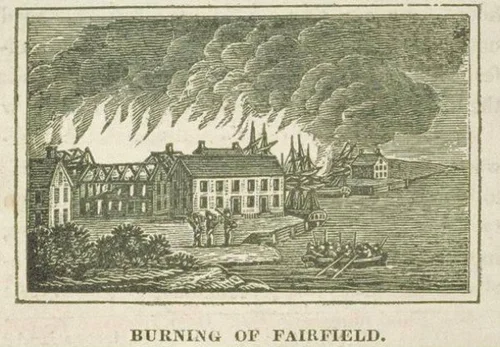
It is unclear to what degree these Beardsleys were affected by war activities happening in and around the original Fairfield and Stratford. It’s entirely possible they moved further inland because of the growing threat of danger. Many coastal towns in Connecticut were targeted by the British Navy; in fact, several Fairfield residents were killed when forces under British General William Tryon attacked and burned a majority of the buildings in 1779. Before this, Fairfield was known for being a Patriot stronghold that the British considered to be a nest of rebel activity.
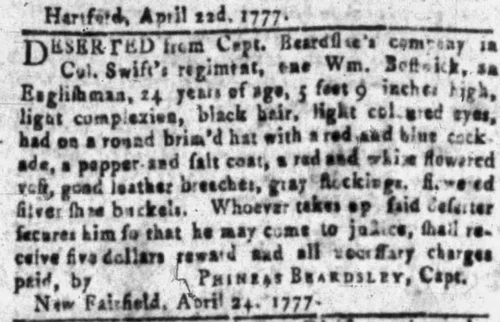
Phineas Beardsley likely joined the army shortly after the war officially broke out in 1776, quickly earning the rank of Captain. His name shows up on Revolutionary War Rolls from 1777 as well as a newspaper clipping from that same year. The clipping, which came from an April 1777 edition of the Hartford Courant, reported the desertion of a 24-year-old Englishman named Wm. Bessick (spelling may or may not be accurate with the quality of the scan) and said that “Whoever takes up said deserter [and] secures him so that he may come to justice, shall receive five dollars reward and all necessary charges paid, by PHINEAS BEARDSLEY, Capt.” His son, Elijah, shows up in the rolls as a private under his charge. He enlisted at only 17 years old.
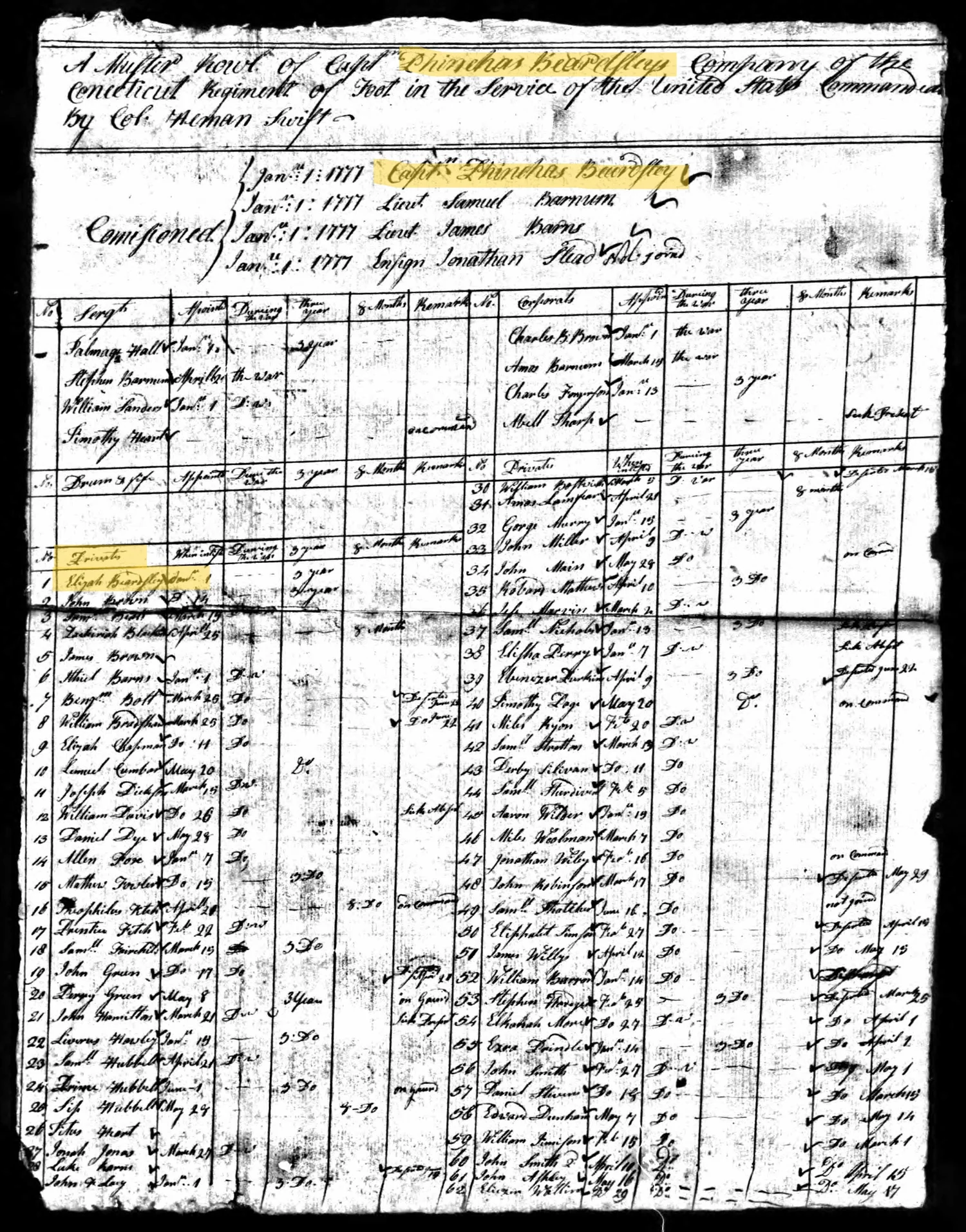
The top of this document reads: “A Muster Roll of Capt. Phineas Beardsley’s Company of the Connecticut Regiment on Foot in the Service of the United States Commanded by Col. Herman Swift.” Confirmed in January, 1777. Both Phineas and Elijah are highlighted.
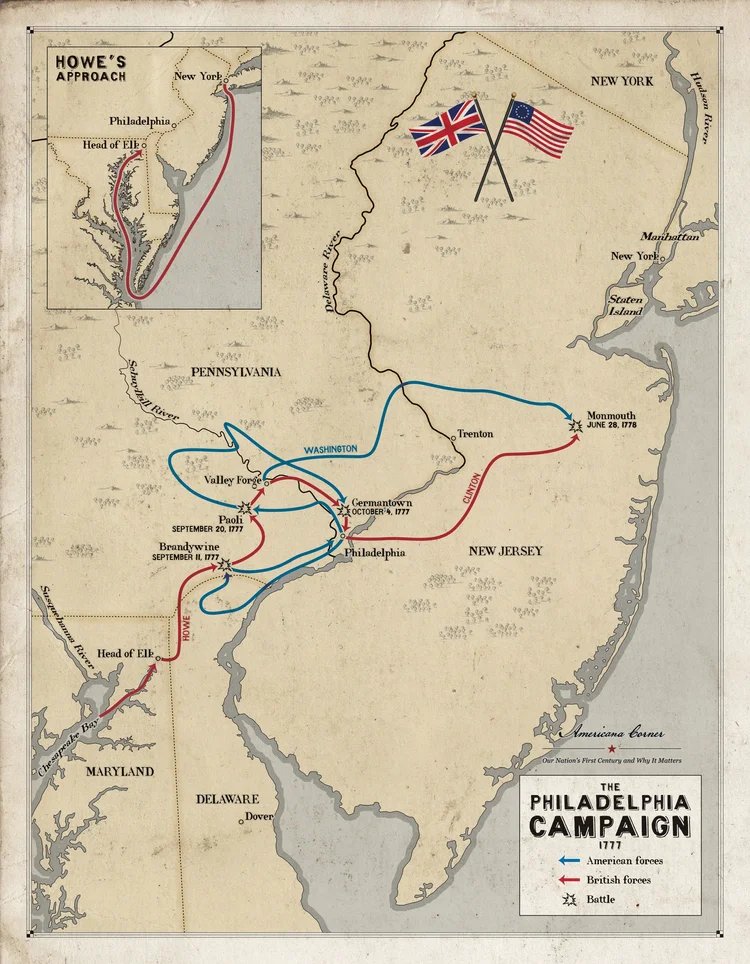
Map of the Philadelphia Campaign by British Forces in 1777-78 from the Americana Corner
Both were part of the 7th Connecticut Regiment, which was authorized on September 16, 1776, and then organized in January 1777 at New Milford, consisting of 8 companies from Litchfield, Fairfield, New Haven, and New London Counties. They joined the Main Continental Army in September of 1777, joining the major battles of Brandywine, Germantown, and Monmouth as part of the 1777-78 Philadelphia Campaign (the British military’s unsuccessful attempt to capture Philadelphia).
Phineas and Elijah both survived their stint in the war. Phineas remained in New Fairfield for the rest of his life, dying in 1812 at the age of 78. Elijah went on to marry Sarah Hubbell in 1780, and the two of them had at least 9 children. One of them, of course, was Havilah Beardsley, born in 1795. Sometime within the last few decades of Elijah’s life, he relocated with his family to Springfield, Ohio, where he died in 1826 – only three years before Havilah settled in Elkhart.
It’s frustrating sometimes to read these records and have to ask, “What about the women? What were they doing? How did they feel?” and find no answers whatsoever. Sadly, the Beardsley women who saw the American Revolution (Ruth and Sarah Hubbell) exist on these Ancestry records only as wives and mothers. In fact, early U.S. census records did not even name women unless there were no men living in their home – they were just numbers, a statistic listed as part of the male’s household.
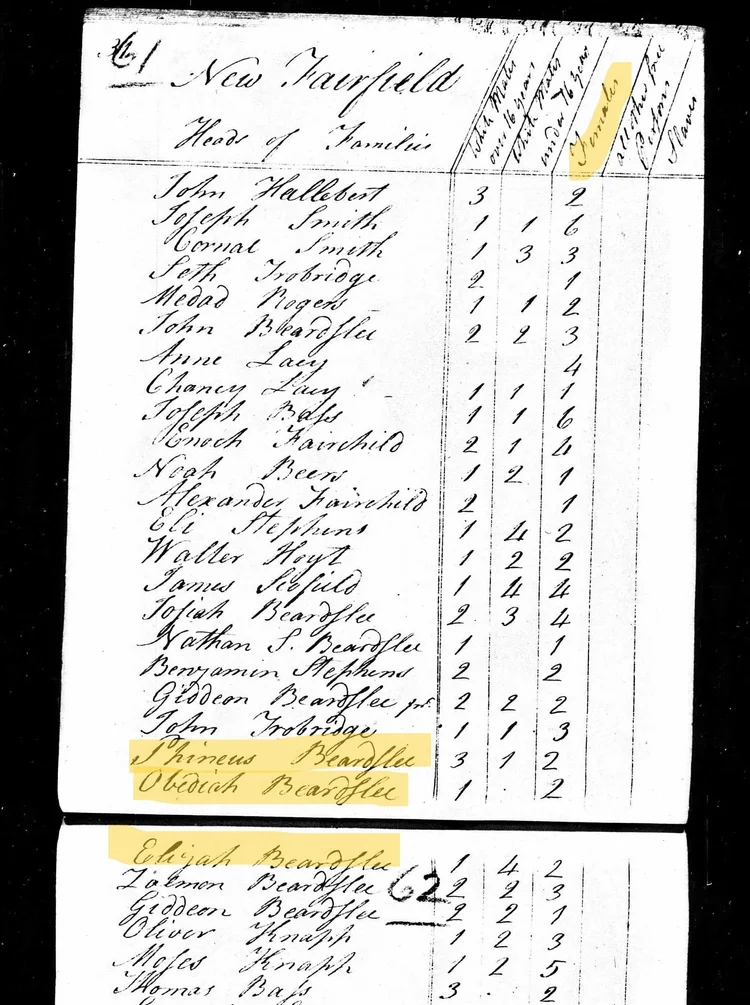
1790 Census listing Beardsley men living in New Fairfield, Connecticut, and “Females” as only a number.
So, where was your family 250 years ago? Care to find out? You can do some digging on your own family history on Ancestry or MyHeritage using our new Family Tree Explorer stations at the Beardsley Discovery Center. With this Ruthmere program, you can enjoy free access to resources that will uncover your past. Just call us at (574) 264-0330 or visit us here to learn more.
Want to share your story or your thoughts on America’s 250th? As part of our commemoration, we are taking part in a county-wide Oral History Project, inviting Elkhart residents to share their reflections, memories of the past, and hopes for the future on this 250th Anniversary of the United States. Learn all about this project and how you can participate here.