
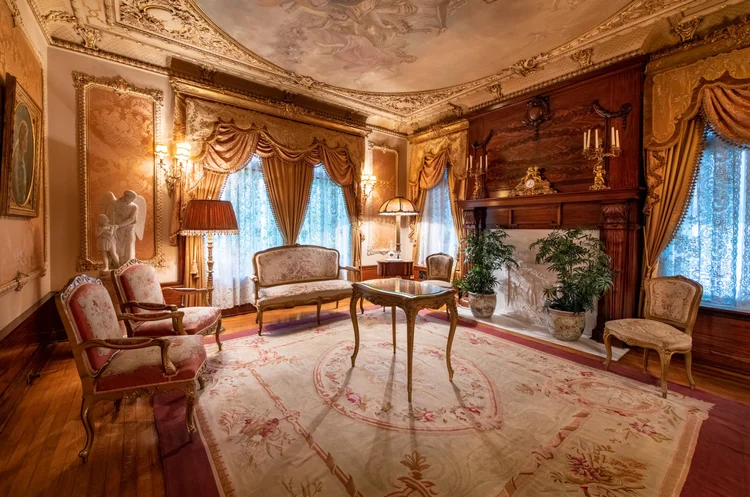
The French Drawing Room at Ruthmere
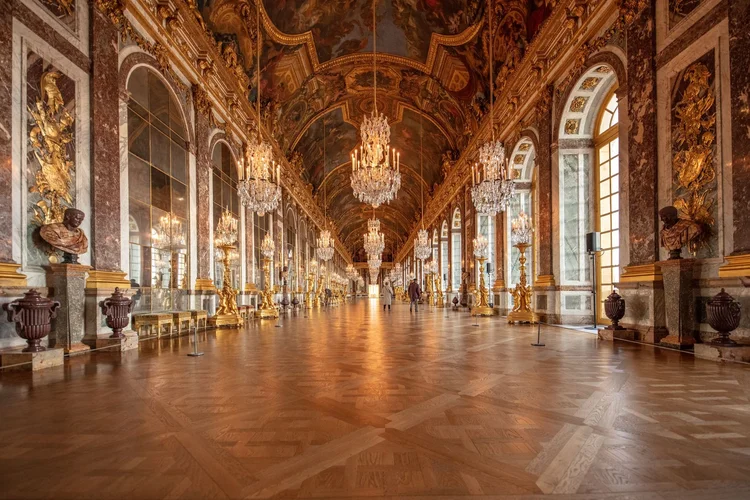
The Palace of Versailles
Have you ever been to France? Do you have fond memories of the exquisite buildings, sophisticated decor, and elaborate gardens, or did you just fall in love with French culture? Do you have an interest in Versailles? What does a fondness for France have to do with Ruthmere? To say “a lot” is an understatement. French influence can be found everywhere at the Ruthmere mansion. This northern Indiana mansion is a great example of the Beaux Arts architecture style which includes decorative influences by French Kings such as Louis XV. There are also many examples of French decor and French art including sculptures by the French artist Auguste Rodin. Prepare to overwhelm your eyes as we take a French tour through Ruthmere!
First, let’s discuss the history and features of Beaux Arts architecture, which means fine arts in French. This style of architecture is named after the premier French school of fine arts , the Ecole des Beaux Arts, and was the main style of architecture taught from the 1830s through 1900. It was intended to be the French national style of architecture but it also became popular abroad, including in America from approximately 1880 to 1920. Typically, the style of architecture was used for academic and public buildings, but some wealthy elite, such as Albert and Elizabeth Beardsley, used this style for their private homes. Beaux Arts architecture reflected wealth that accumulated from the Industrial Revolution across the world so it naturally followed that the style largely died out in America due to the Great Depression.
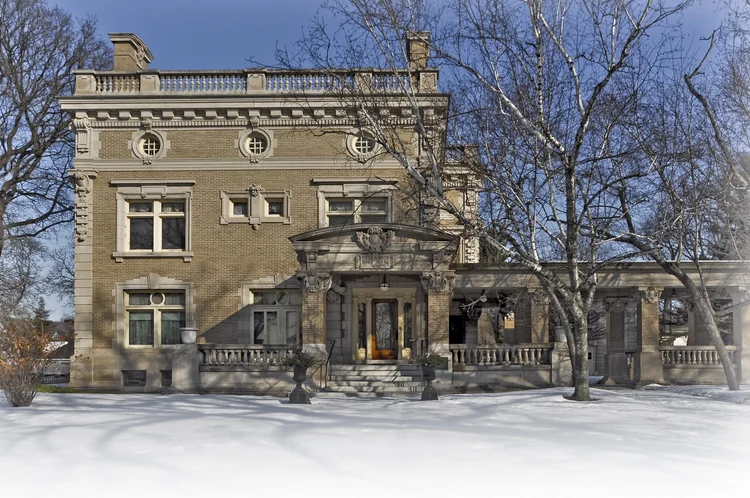
Ruthmere Mansion in Winter
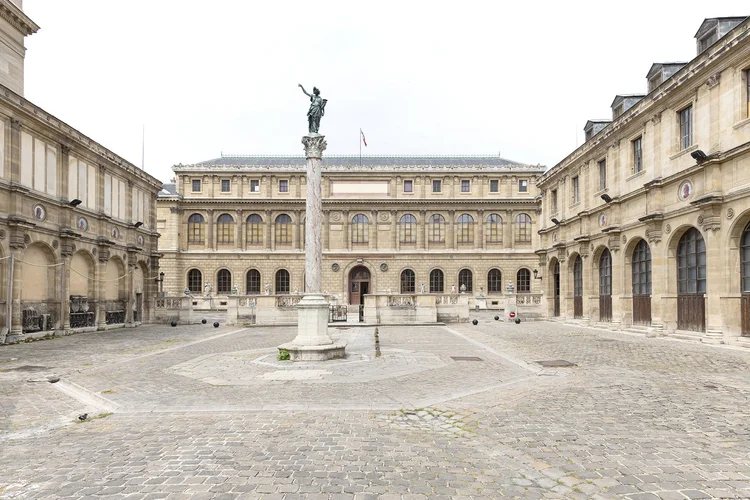
The Beaux-Arts de Paris, a top-level arts institution in France
Primary characteristics found in the Beaux Arts architectural style include a flat roof line and a rusticated and raised first story. Rustication of the first story includes rough stonework that contrasts with smoother stone surfaces called ashlar. Beaux Arts architecture also uses a hierarchy of spaces that includes grand rooms with grand staircases and utilitarian spaces with simple staircases. Arched and pedimented windows and doors are also features of a Beaux Arts design house, as well as symmetry and classical architectural details. Classical details can include balusters, or spindle stick railings; pilasters, or flat columns extending from the wall; cartouches, or a convex oval design with ornamental scrollwork; acroteria, or architectural ornaments place at the apex and/or corners of a pediment; agrafe, which are richly detailed clasps or supporting brackets; and festoons, which are architectural wreaths or garlands hanging from two points. Artwork - including statues, sculptures, murals, mosaics, and bas-relief panels - are also an important part of a Beaux Arts building or home.
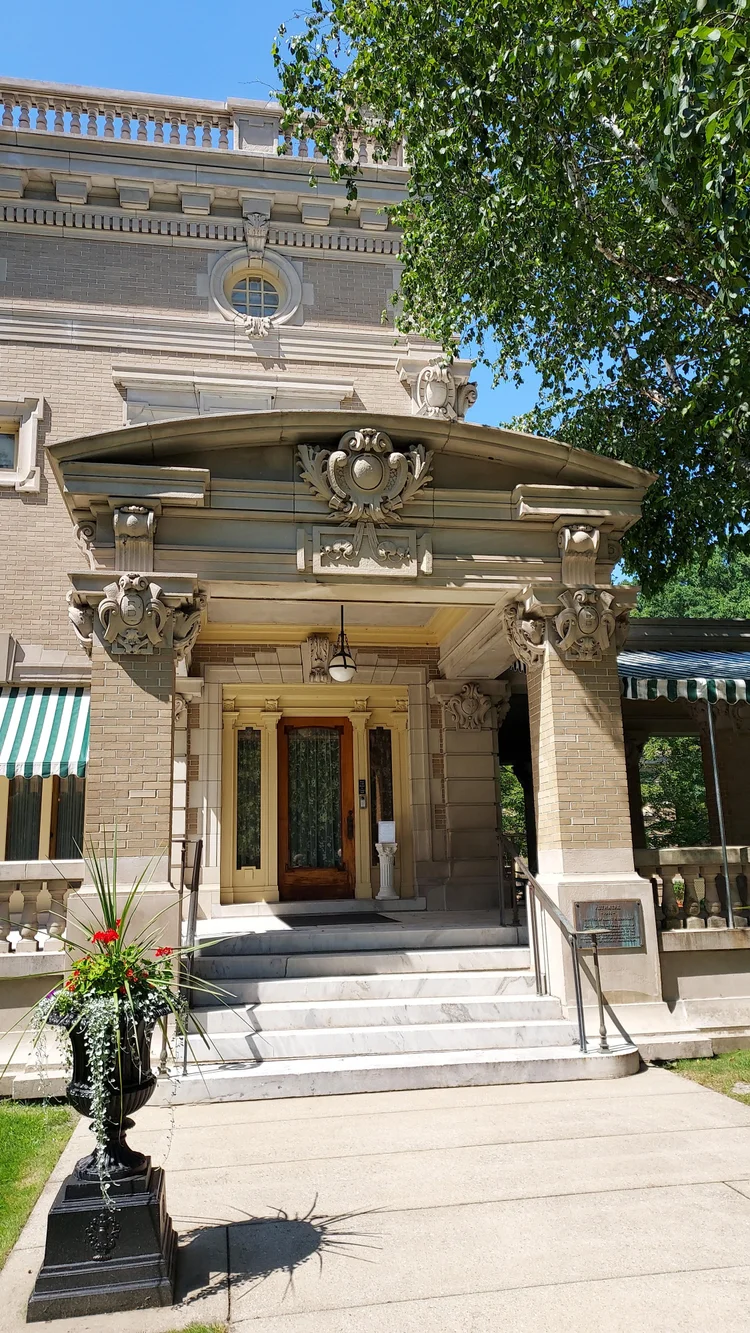
Ruthmere’s Front Entrance
Simply walking up to Ruthmere, you can see the house has an impending presence with a raised first story and grand detailed stonework or rustication on the exterior of the house. There are stone balustrades around the property on the front porch and along the outline of the flat roof, pomegranate cartouches atop pillars and doorways, and a large pomegranate cartouche at the center of the pediment. Some of the stonework appears to look like an arched pediment above the front door and you can also see a detailed agrafe centered above the front door.
When you first enter the Ruthmere mansion, it is easy to be overwhelmed by the tall ceilings and the amount of details on the walls and ceilings. Beautiful Cuban Mahogany wood, and detailed colored stencil paintings and artwork cover the walls in the entry way and front hall. All of the doorknobs have tiny pomegranate cartouches both on the knobs and on the metal around the knob. You also find pomegranates everywhere in the front hall in many different decorative forms: stenciled on the ceiling, carved in the pilasters, and carved in latticed woodwork. There is a Louis XV style gilded wood pier table console with an Italian marble top in this front hall. We also have a Portrait of Daniel Webster by G.P.A Healy who studied in France and lived in France for 2 decades.
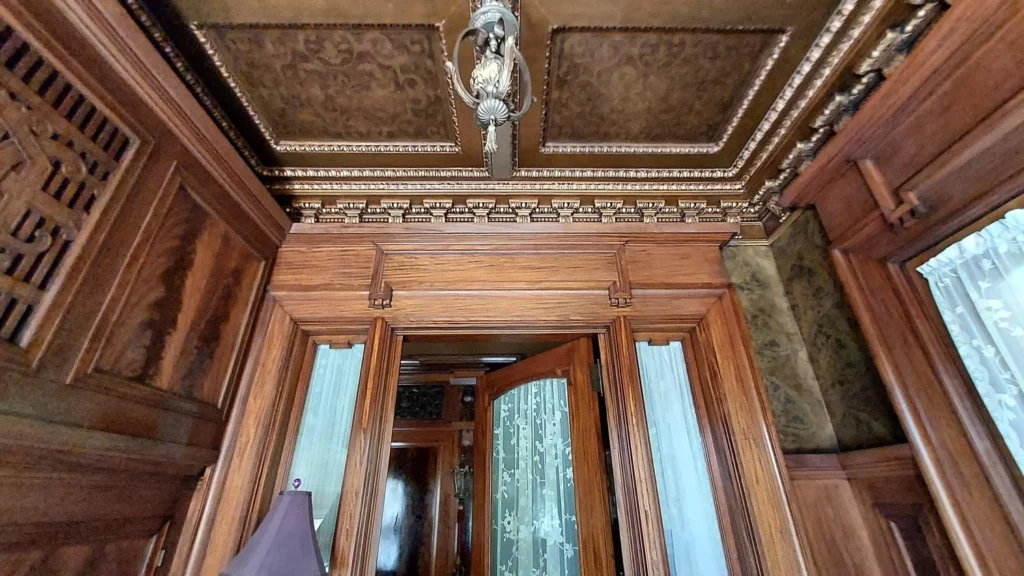
Ruthmere vestibule ceiling
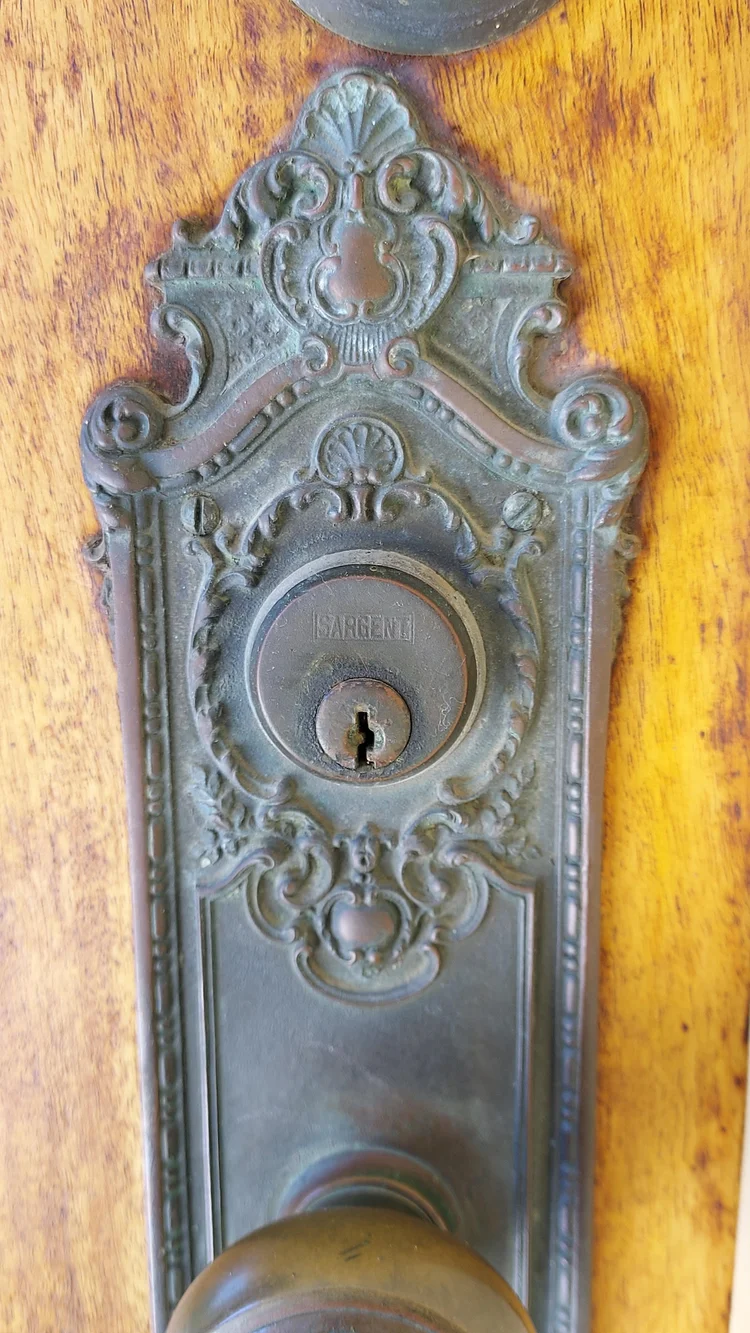
Ruthmere doorknob
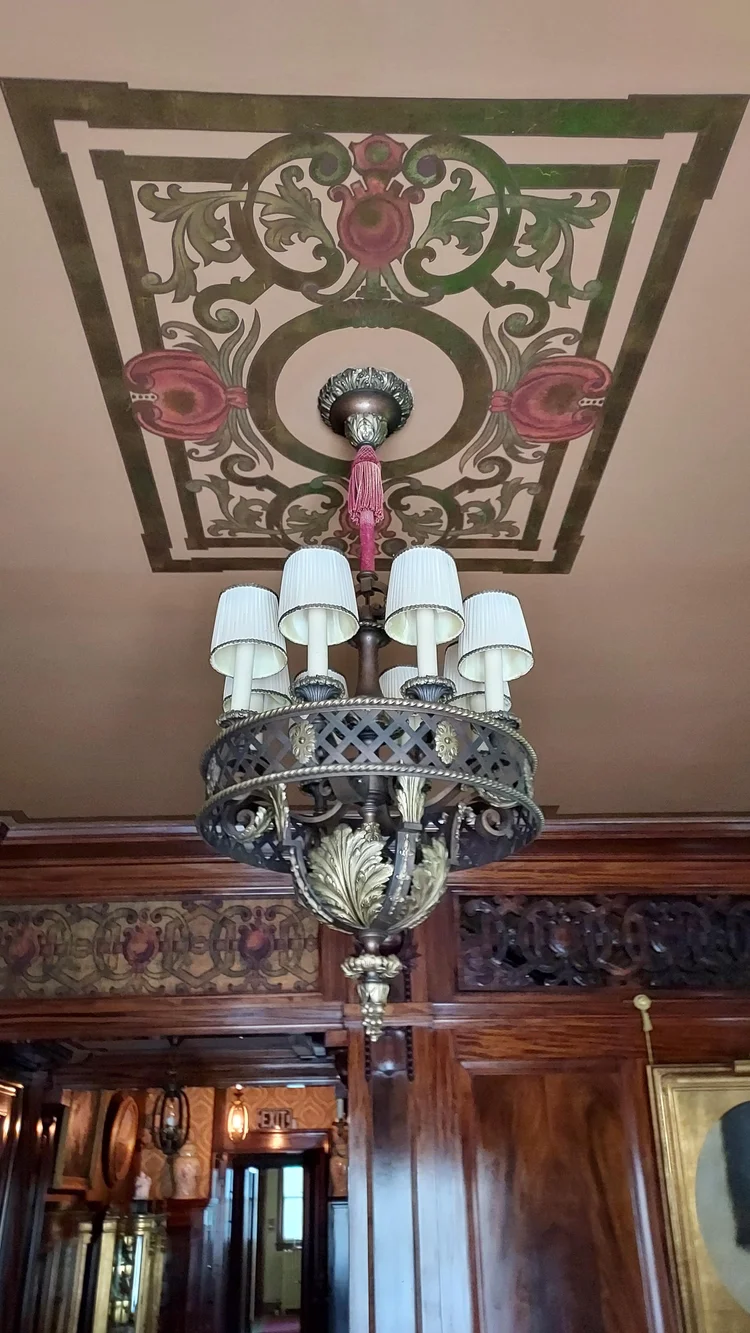
Ruthmere foyer chandelier with pomegranate designs painted on ceiling. You can also see pomegranates on the upper wall behind the chandelier
The drawing room is one of the French highlights of the whole mansion. In 1920, a newspaper article from The Elkhart Truth referred to this room as the French room. The walls are highly decorated in this room with Louis XV French-inspired silk wall coverings and there is a bas-relief panel at the bottom of the fireplace. As for furniture, there is a French marble top vitrine, or glass display case, and Louis XV styled chairs, settee and tables. Also in this Drawing room is a French Aubusson rug. More than 100 of these rugs were also found on a 1786 inventory list of the Palace of Versailles. Ruthmere’s drawing room is visually overwhelming, much like a room in Versailles.
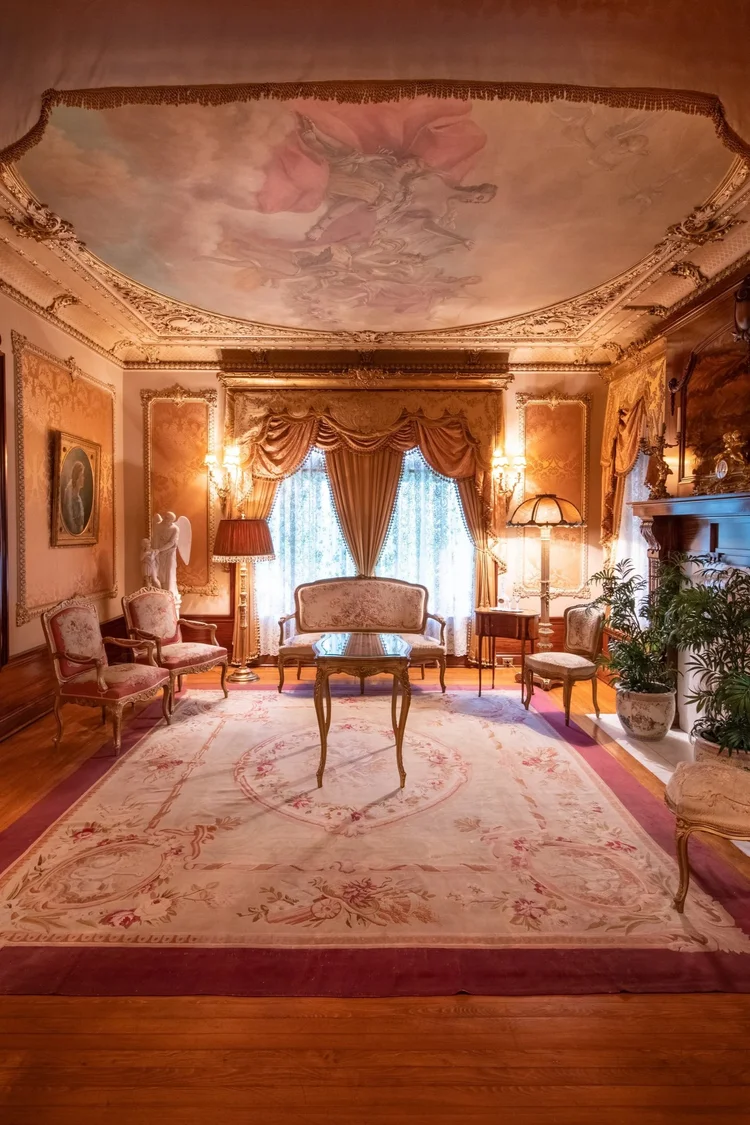
The French Drawing Room
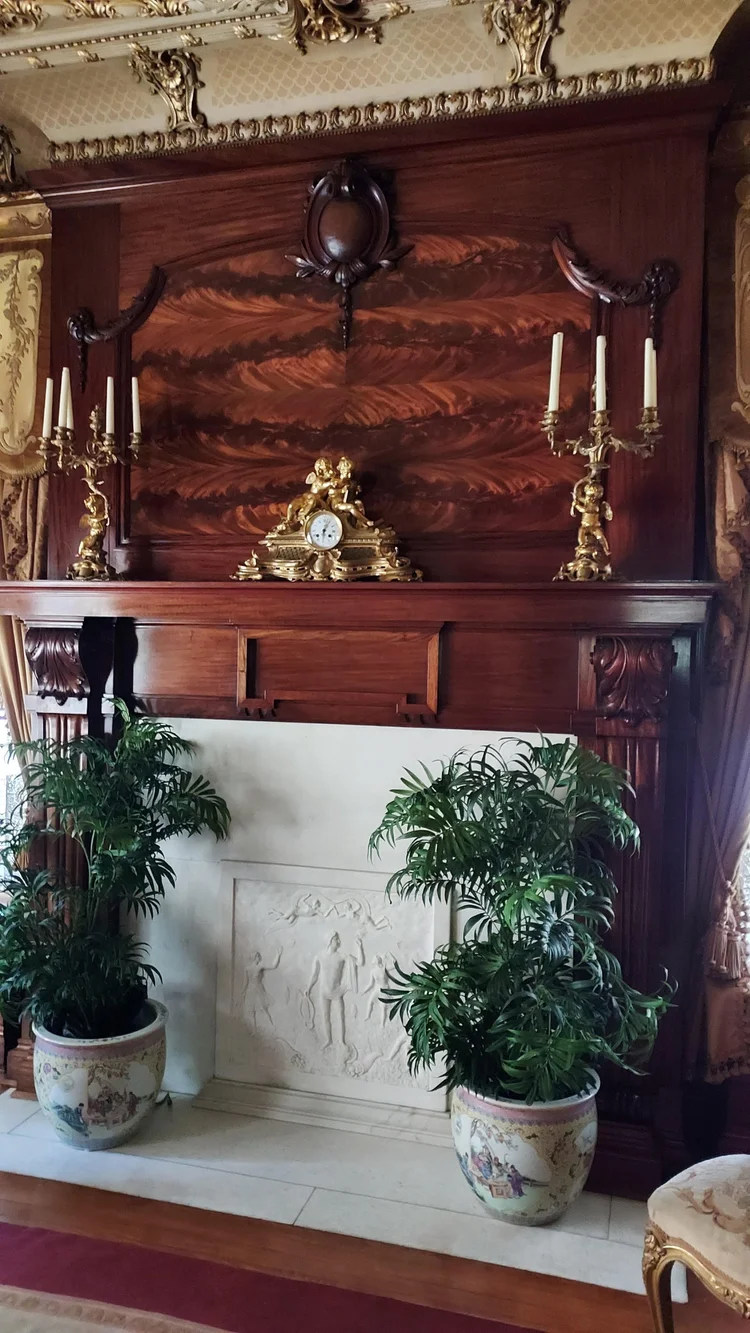
The fireplace in the French Drawing Room with cover
When you enter the library, you probably immediately notice several sculptures all around the room. In here you can find 3 different bronze castings of sculptures by the French artist Auguste Rodin who was probably best known for his statue, The Thinker. The library contains Rodin’s Man with a Broken Nose, Daphnis and Lycenion and Fugit Amor. There is also another vitrine from around 1880 that is in the style of Louis XV where there is a bronze sculpture by Antoine-Louis Barye, another French sculptor.
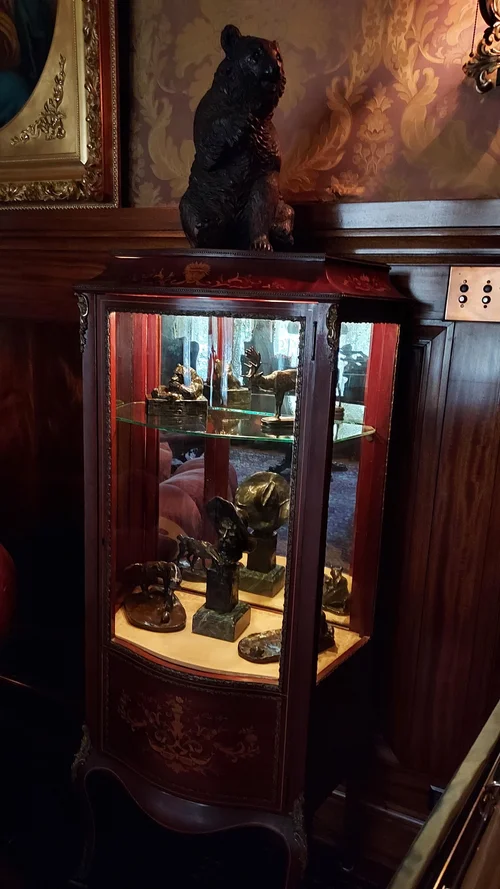
The library vitrine
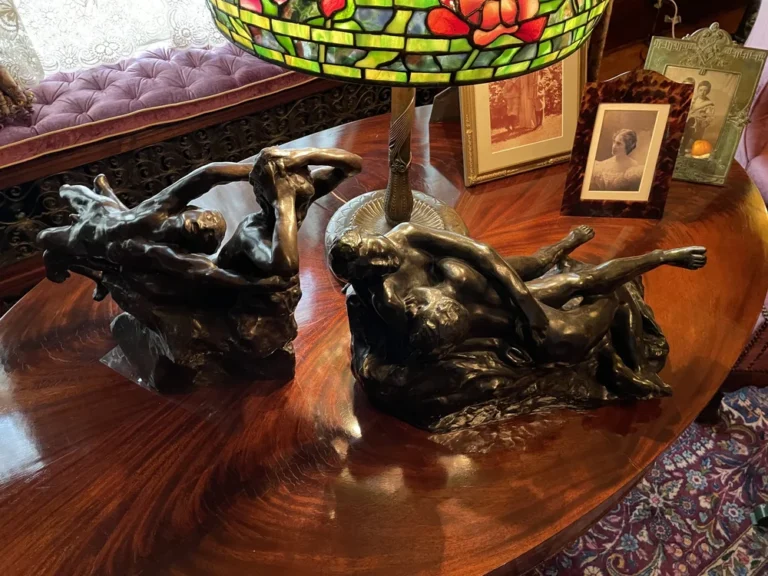
Daphnis and Lycenion and Fugit Amour by Auguste Rodin, bronzes in Ruthmere’s library
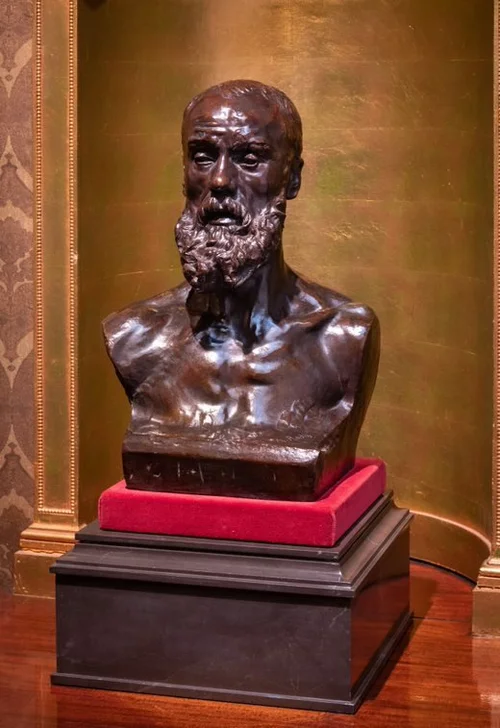
Jean Paul Laurens, bronze by Auguste Rodin
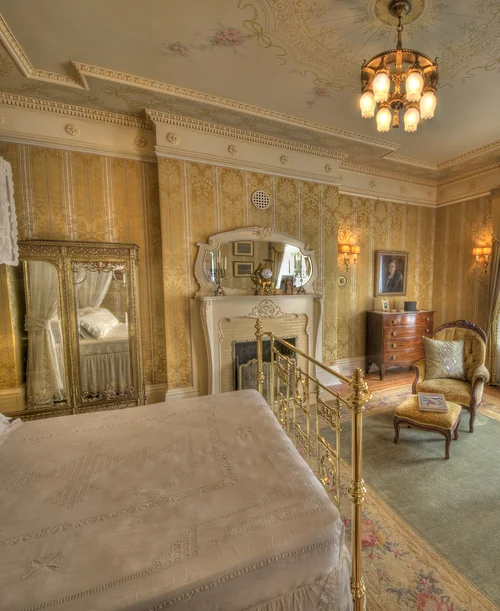
Albert’s Bedroom
As we go up the grand staircase to the 2nd floor landing, we find several different pieces with French connections. There is another bronze casting by Rodin called Jean Paul Laurens, an original chandelier in the style of the French Renaissance movement, yet another French vitrine that contains Elizabeth’s dolls, and a painting called The Lost Profile by William Morris Hunt. Hunt had a French art teacher and helped introduce the French Barbizon School of Art to mainstream American painting.
Albert’s bedroom has simpler details than some of the other grand rooms in the house, but we still have several French influences. Again, there are French silk wall coverings like we saw in the drawing room. Furniture items done in Louis XV style include a gentlemen’s French armoire and a fireplace mantle. There is also a French gold colored elephant-shaped clock on the fireplace mantel.
Elizabeth’s rooms are unique because we find small French decorative details around the silk wall panels that are only seen in the French drawing room. According to a Beardsley family member, Elizabeth probably liked the idea of being known as the local duchess and her room seems to reflect that. As expected, we do find some Louis XV inspired furniture as well as a portrait of the French princess Sophie Philippine Elisabeth Justine who was the eighth daughter of King Louis XV.
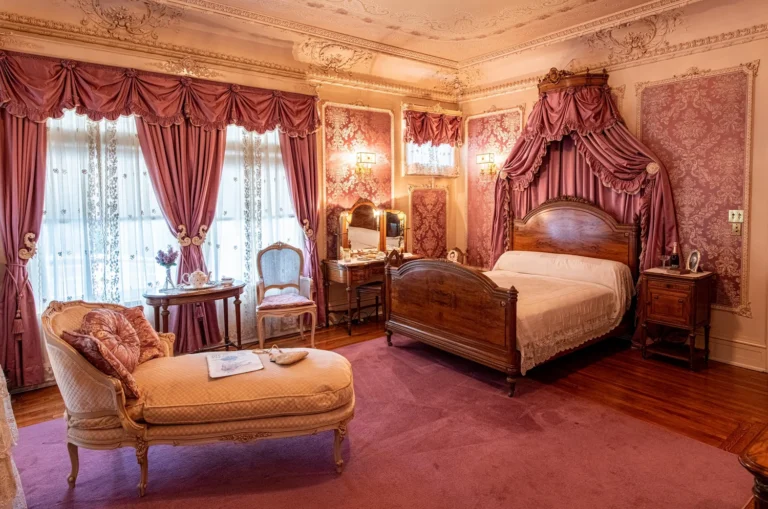
Elizabeth’s Room
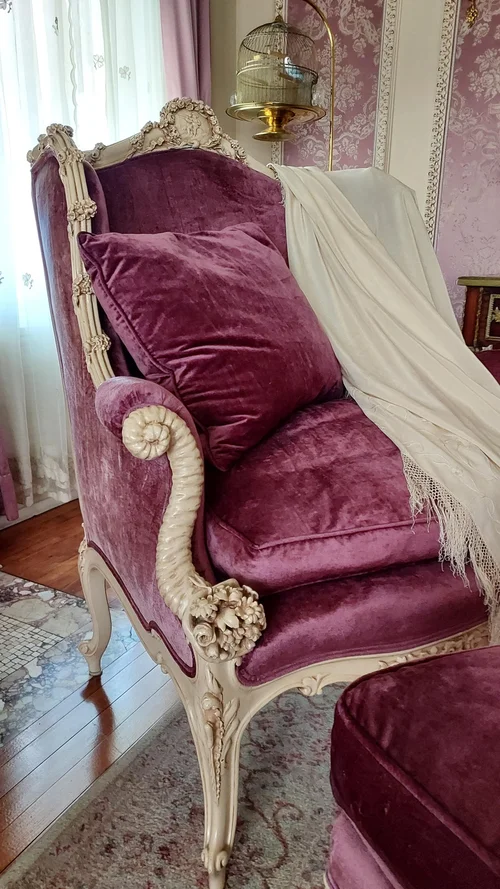
Chair in Elizabeth’s Morning Room
As we proceed to Elizabeth’s Morning Room, there are more examples of Louis XV style furniture as well as a tea table and desk in the style of Louis the XVI and a Bombay commode in the style of Louis XIV. Completing these very French rooms for Elizabeth is a marble bust of Marie Antoinette.
The guest room is next, and we find a French wrap print stencil on the ceiling as well as a 19th century silver-plated French clock with a bellflower decoration. From here, we go into the service quarters of the house which are much more utilitarian due to the Beaux Arts hierarchy of spaces. This hierarchy applies not only to very noticeable things like staircases, but also less noticeable things like doorknobs.
Passing through the kitchen, we come to the butler’s pantry where there is a Vieux Paris (Old Paris) porcelain dinner service with red and gold trim which is said to have been used to serve President Lincoln for a dinner party. Then we enter the dining room and return to grandeur. Here, there are many pilasters, a large mural on the upper half of the wall that goes all the way around the room, and French doors that lead to the piazza.
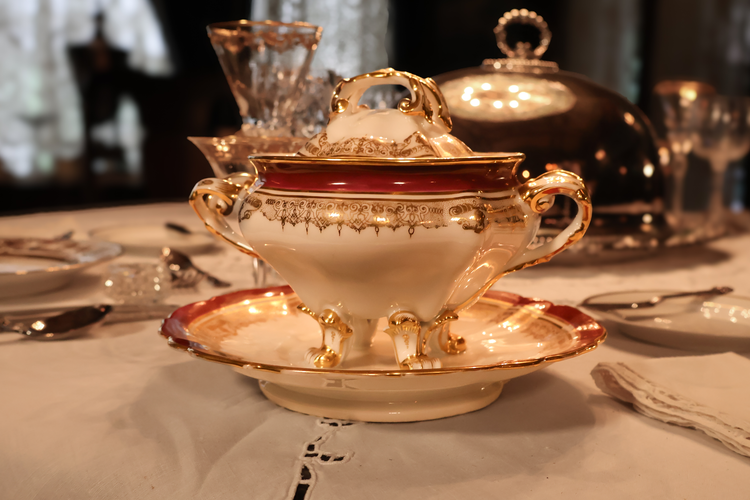
Piece from Vieux Paris porcelain dinner service
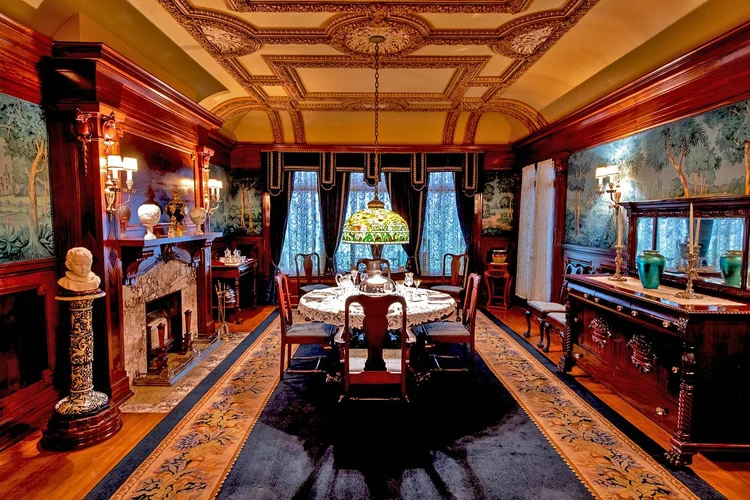
Ruthmere Dining Rooms (French Doors on right)
If we were to pass through the French doors to the piazza, a beautiful view of the French blue and white garden would be found below. This formal ornamental garden has all the classical elements, such as a water feature, a statue, geometric flower beds, white stone paths, and flowers of calming blue and white hues.
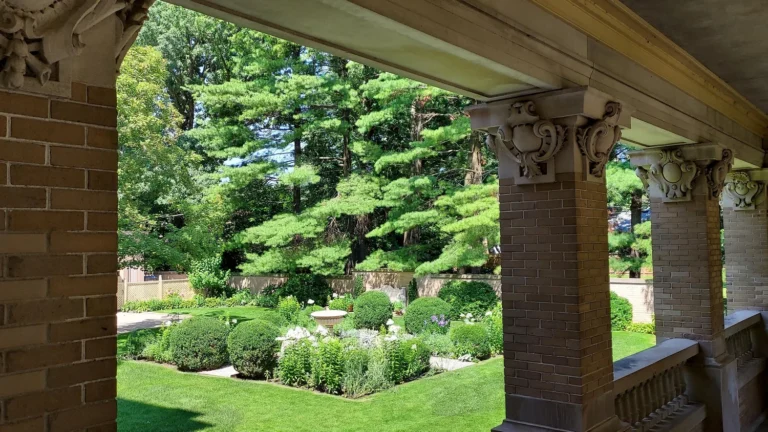
Ruthmere’s Blue & White Garden (sometimes referred to as the Wedding Garden)
If you are specifically interested in French art, we have an arts and reference library on the second floor of the garage that is not normally part of the tour, but you can see it by appointment. We have Camile Claudel’s sculpture known as L’Implorante or The Imploring Woman. She was another French sculptor that worked closely with Auguste Rodin and she was known for her ability to convey raw emotion through marble and bronze.
The amount of detail I have described does not compare to the visual feast of actually seeing this place. I hope you have enjoyed the French history, influences, and art found in the Ruthmere Mansion and we hope you are inspired to take a tour!